Herb
Balbas pusa (Orthosiphon aristatus) Herbal Medicine, Health Benefits, Side Effects
Also known asBalbas-pusa (Filipino); Kabling-parang (Pilipino); Yaa-nuat-maeo (Thailand); Cat’s whisker (English); Indian kidney tea (English); Java tea (English); Kidney tea (English); Mao xu cao (Chinese); pokok misai kucing (Malay) Orthosiphon aristatus
On this pageWhat is balbas pusa?
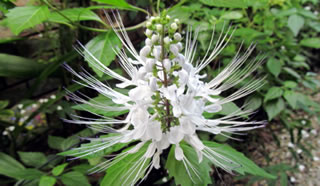
Balbas pusa, also called Java tea or cat’s whiskers, is Orthosiphon aristatus. The leaves have a long history of traditional use for urinary complaints and as a mild diuretic.
European regulators recognize Java tea leaf as a traditional herbal medicinal product for increasing urine output as supportive care in minor urinary complaints. That classification is based on longstanding use. It is not evidence that Java tea treats kidney infection, chronic kidney disease, or kidney stones.
What is balbas pusa?
Orthosiphon aristatus is a tropical plant native to parts of Southeast Asia.
Its long stamens resemble whiskers, which explains the common names cat’s whiskers and balbas pusa.
Other names include Java tea, kidney tea, Indian kidney tea, and misai kucing.
What is Java tea traditionally used for?
Java tea has traditionally been used to increase urine output and for minor urinary complaints.
Traditional diuretic use should not be confused with treating kidney failure, urinary infection, or urinary obstruction.
What does research show about Java tea?
Human research is limited.
Urine flow and urinary complaints
Laboratory and traditional-use evidence suggests a diuretic effect. This is the basis for its long-standing use to promote urine flow.
Producing more urine is not beneficial for every urinary problem.
Kidney stones
Java tea has been studied in people with kidney stones, but evidence does not show a clear benefit.
A randomized placebo-controlled study found no statistically significant advantage over placebo in people with nephrolithiasis.
That trial does not support claiming that Java tea dissolves kidney stones.
Laboratory and animal findings
Research has examined antioxidant, anti-inflammatory, blood-pressure, glucose, and kidney-related effects of Orthosiphon extracts.
These preclinical findings should not be used as evidence that Java tea treats diabetes, hypertension, kidney disease, or infection in humans.
How is Java tea used?
Traditional products commonly use dried leaves as tea or as standardized herbal preparations.
Commercial products may also be sold as capsules, tablets, or extracts.
The concentration can vary substantially.
Is there a standard dose?
There is no single worldwide medicinal dose for all Java tea products.
Registered products should be used according to their labeling.
What are the side effects?
Available safety information is limited.
The absence of common established adverse reactions does not prove that every preparation is risk-free.
Allergic reactions or gastrointestinal symptoms are possible with herbal products.
Does Java tea interact with medicines?
No established interactions are known for traditional use, but clinical interaction data are limited.
Caution is reasonable when taking medicines that increase urine output, lower blood pressure, affect kidney function, or alter fluid and electrolyte balance.
Who should avoid Java tea?
Medicinal use is not generally recommended in children and adolescents because adequate data are lacking.
Pregnancy and breastfeeding safety is also not established.
Java tea should not be used when increased fluid intake is medically inappropriate, such as in some people with edema caused by impaired heart or kidney function.
Medical evaluation is important if urinary symptoms include fever, painful urination, urinary spasms, or blood in the urine.
Frequently asked questions
Is balbas pusa a diuretic?
It has a long history of traditional use to increase urine flow.
Does Java tea treat kidney stones?
Evidence is insufficient.
Can Java tea treat a urinary tract infection?
It should not be used as a replacement for appropriate diagnosis or treatment of a urinary infection.
Is Java tea safe in pregnancy?
Medicinal use is not recommended because pregnancy safety has not been established.
About this article
- Written by
- MedicalHealthGuide Editorial Team
- Updated